
This week’s post is a deep dive on Tony Robbins’ Decision Maker Process from his recent interview with Jay Shetty.
Insight 1: Writing down your desired outcome creates the foundation for any good decision.
Insight 2: Always have 3+ options. One option removes your agency. Two is a dilemma. Three gives you real freedom.
Insight 3: A decision is just the start. Commitment adds energy. Resolve means you’ve made it part of your identity.
Decision making can be stressful. Whether it’s a career move, a team restructure, or choosing the right technical architecture, the weight of “getting it right” can paralyse you. Having a simple process focuses your energy and reduces that stress.
Tony Robbins breaks it down into 6 steps: OOC/EMR.
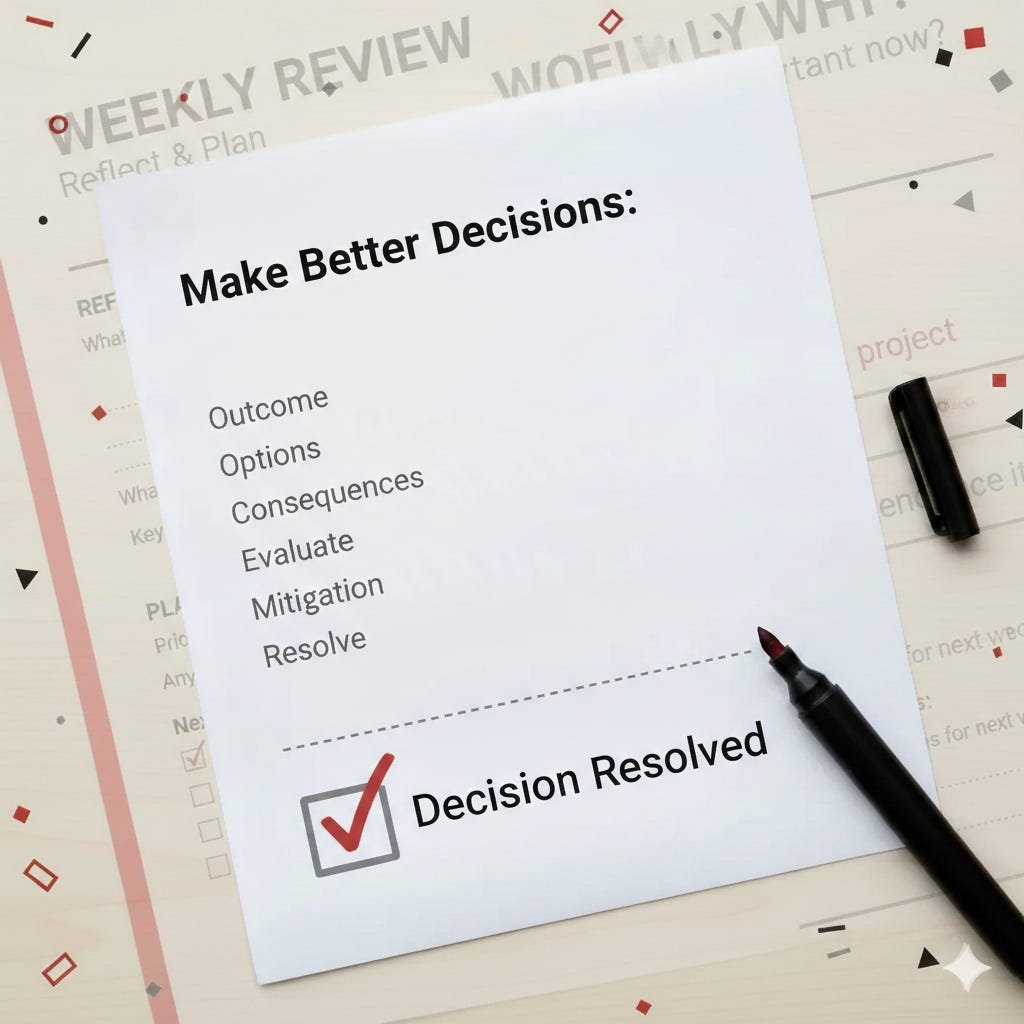
1. Outcome: What Do You Actually Want?
Clearly stating what you want gives you clarity. This sounds obvious, but most people skip this step. They jump straight into weighing options without defining what success looks like.
If you don’t know where you’re going, no road will get you there.
Write it down. Be specific. This becomes the foundation for everything that follows.
2. Options: Get to Three (Minimum)
This is where most people get stuck. They see two paths and feel trapped.
One option removes your agency. There’s no choice at all.
Two options create a dilemma. You’re caught between them, often paralysed.
Three or more options give you freedom. You can mix and match. You can get creative. You stop feeling trapped and start seeing possibilities.
I’ve seen this in technical decisions too. “Should we use microservices or monolith?” is a dilemma. Add a third option, maybe a modular monolith, and suddenly you’re thinking differently and creatively about where domain boundaries should be.
3. Consequences: Upsides and Downsides
For each option, map out both the upsides and downsides. Be honest about both.
This step forces you to think through what could go right and what could go wrong. It’s easy to romanticise an option or catastrophise another. Writing it out keeps you grounded.
4. Evaluate: Separate Likely from Fantasy
Here’s where you filter out the noise.
“Don’t stress about low-likelihood disasters, or fantasize about near-zero upsides.”
That worst-case scenario you’re terrified of? How likely is it really? That dream outcome you’re banking on? What’s the actual probability?
Focus on what’s probable, not what’s possible.
5. Mitigate: Reduce the Downside
Now you know what could go wrong. How can you reduce it?
Can you de-risk the decision? Can you run a smaller experiment first? Can you build in a safety net?
This step turns scary decisions into manageable ones.
6. Resolve: The Difference Between Deciding and Being Done
“most people think a decision is the end. It’s only the beginning.”
There are three levels:
Decision is a choice in the mind. It’s still unstable. It can feel like internal conflict.
Commitment adds energy and action. You’re investing effort to make it real. This is where discipline matters.
Resolve is identity-level certainty. “I’ll find a way or I’ll make a way.” No fear, no second-guessing. You’ve ended the internal war.
He compares it to elite athletes. You can see when someone lacks resolve before the shot even happens.
Ask yourself: Am I just decided? Am I committed? Or am I truly resolved?
A simple 6-step process can reduce decision-making stress, give you clarity about your goal, and build confidence that you’ve made a well-thought-out decision.
I’ve put together a one-page PDF worksheet based on this framework.
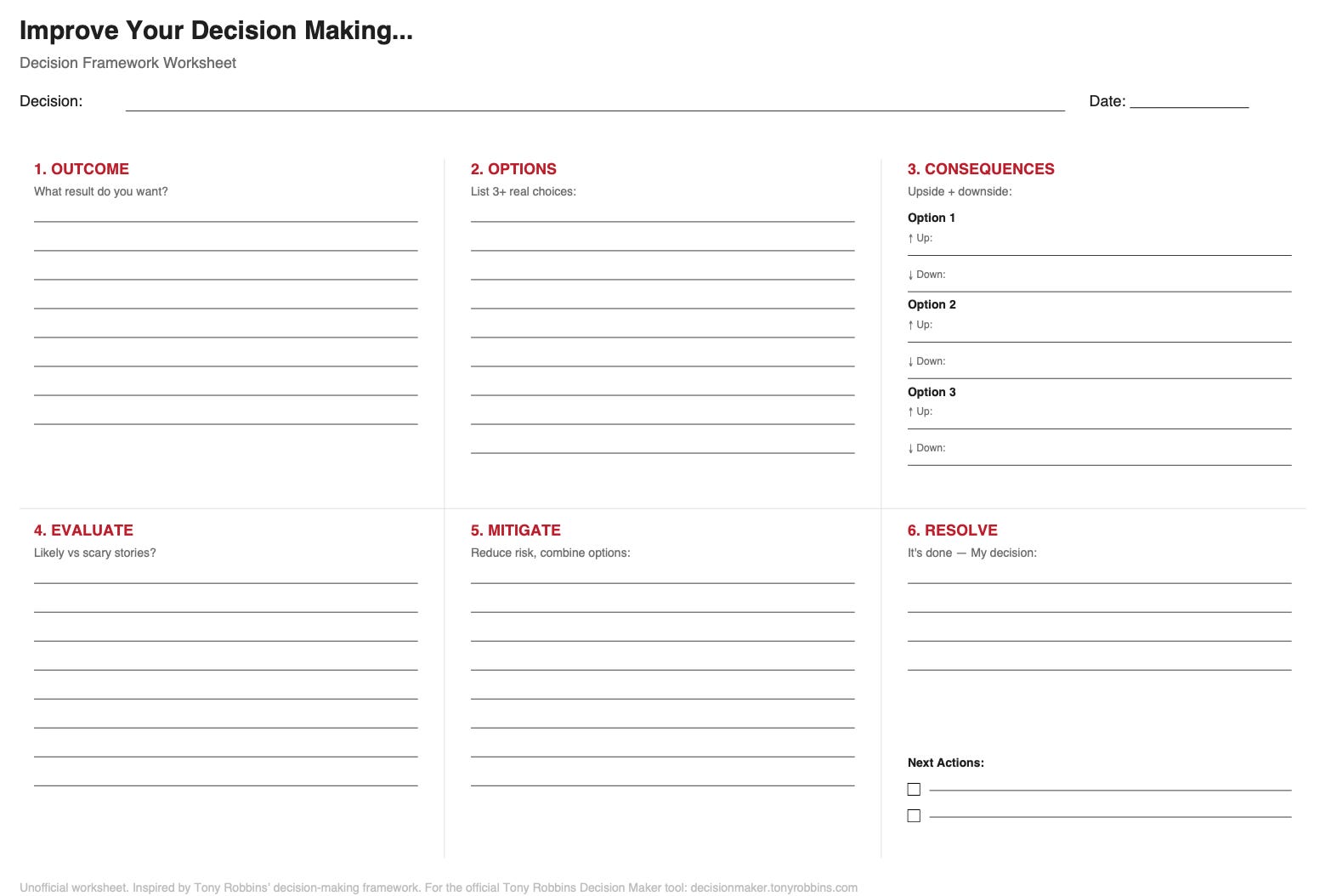
Download it here…

For the official Tony Robbins interactive tool, check out https://decisionmaker.tonyrobbins.com/
Have a great week.